
Introduction
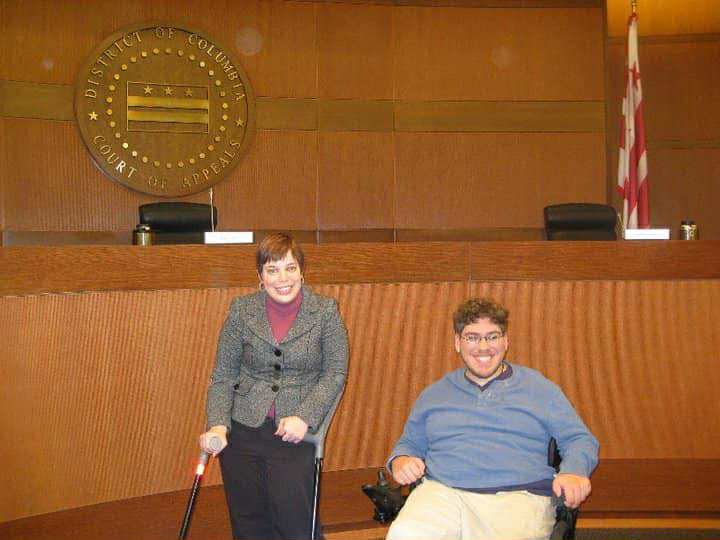
This was taken Friday, November 5, 2010.
Contrary to what many may believe, a semester or quarter of college does not equate to a year of high school. Nancy Allen, who used to be the sign language interpreter coordinator when I was a student at Highline College told me that multiple times. That is a disablist, unprofessional micro-aggression. It takes native speakers two full years to become fluent enough to interpret. Here is the syllabus for GSR 103 from Fall 2011. I had to retake it after flunkin’ it my first term because the professor was too busy getting drunk with other students to give me access to his Blackboard shell. Here are statistics for the following year after I was admitted. Despite having signing the medical withdrawal paperwork two days before the deadline, having a now-DOJ attorney attempt to deliver it (and several other things) to the University multiple times, I still had all failing marks my last semester for over seven and a quarter years.
Statistic or Typo? The World May Never Know…
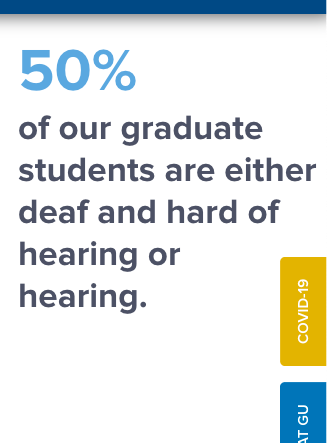
Taken from the official Gallaudet University Web site on / around September 3, 2022.
My Involvement in The GU Honors Program
My dedicated Honors courses for GSR 101H and 150H are not noted as such on my transcript, even though my AP score is is marked as an Honors option course that made the Registrar put me in two (2) major-level political science courses my first semester.
I provided the captions file for the current Honors Program advertisement. Here is the Honors Capstone advertisement for the year I was expected to graduate. I actually have a professional endorsement / reference from a previous Director of Financial Aid, but she is no longer there; however, one of my professors from my first semester who taught GOV 301, “Introduction to Political Theory” still is; he got a second master’s and a doctorate, and he is now tenured.
Abolish The College GPA…
In high school I studied 24/7, never did anything fun, was in a million clubs, and took all Advanced Placement courses,” she captions the beginning of her video. The camera transitions to a friend flipping off the camera. “This mother-fucker had beef with every teacher and dropped his only club and had fun. We both ended up at the same college. Don’t be me. Go have fun.”
Her TikTok is an ode to the movie BOOKSMART, which follows a high school gunner obsessed with getting into the Ivy League. In one of my favorite scenes, the main character finds out that a seemingly underachieving classmate will be attending the same school as her. She feels shocked, even cheated. As the scene ends, a voice in her head echoes, “You’ve worked harder than anyone who’s ever doubted you. Worked harder, worked harder, worked harder …”
…
This theme speaks to a growing culture among many students, in part because of the ways so many schools in the United States foster gatekeeping and competitive environments. “Working hard” is expected to result in acceptance to a “good” college, followed by the promise of a job. And when peers who have “worked less” end up at the same institutions, there is a feeling of unfairness, followed by questions like “Could I have gotten away with less?”
The education system has come to reinforce capitalist ideas, teaching students that anything is possible with hard work and that their achievements are deserved, even though academic institutions are structurally designed to be inequitable. GPAs and test scores, for example, are shallow and easily skewed representations of intelligence, but are still widely used to determine admissions and funding. In light of the pandemic, schools are finally being forced to attempt alternative forms of evaluation and learning, and to more deeply consider students’ needs.
I attended a competitive public high school in a Southern California suburb, where attending SAT prep classes in the summer was a norm. The school had the kind of reputation that drew families to the area, hoping to get their kids zoned. Classes started at 7:30 A.M., and students who participated in extra-curriculars usually didn’t leave campus until 5 P.M.. Exhaustion and burn-out culture were so glorified that the school eradicated class rankings in an attempt to ease competitiveness. Nerds were more respected than jocks, and at the end of every academic year, a Facebook group circulated for students to announce what college they had committed to.
I enjoyed learning but didn’t participate in the cut-throat environment, especially after watching my friends stress. When I moved on to higher education, I took what I needed from institutions (degree credentials, facilities and resources, certain classes and professors) and went through the motions for anything that didn’t serve me (testing, core classes, awkward networking). My brother, on the other hand, had dreams of becoming a lawyer since age fifteen—and often worked until he had permanent bags under his eyes.
In high school, he slept an average of five hours a night and was part of a friend group that vigorously pulled all-nighters, completed assignments others might call busywork, enrolled in a mix of AP and “easy A” courses to boost their GPAs, and strategically divvied up club leadership positions. “Every November,” he told me, they “underwent a hell week that we saw as a rite of passage,” consisting of mock trial, Model United Nations, and debate tournaments that ran over multiple days. When he fell sick during one of these hell weeks, a friend guilt-tripped him for ditching the group.
After college, my brother worked as a paralegal; many of his high school peers also went on to work at law firms, banks, or management consulting firms, places where employees work with intangible assets and joke about “selling their souls.” Years of throwing themselves into the school system had primed them for the late nights and tedious tasks that corporate jobs all but require. Their positions could be lauded as measures of their intelligence and hard work, but they are equally due to their access to resources.
There are numerous barriers to entry in academic institutions, including letters of recommendation, GPA minimums and degree requirements, insufficient access to disability accommodations, legacy admissions/nepotism, narrow teaching methods, segregation and lack of school resources, and the questions of time and money: who has to work and support their families while attending school; who can afford private tutors, extracurricular fees, test prep courses, and tests themselves; whose parents have the time and ability to help with schoolwork. Students who are able to overcome systemic barriers are often championed as tokens of diversity and proof that anything is possible with hard work, when these success stories are, for the most part, singular exceptions to the rule.
Source: Tran, Mai. It’s time to abolish the college GPA. 1. December 2020. Web. Accessed August 11, 2026.
Case in Point: Two Alumni of the Gallaudet University Class of 2014
Nick A. Williams and I matriculated into GU in the same year: he was a double major in English and sociology with a subspecialization in criminology; I was a double major in English and political science.
I tutored him through the LSAT and got his score up from a 128 to a 154—above the median in between having multiple eye surgeries. We took the same decommissioned exams from the LSAC; he had to sue in order to get accommodations during the process. He took off multiple times in law school to have surgeries for his sarcoidosis. I interpreted the details of EVERY SINGLE medical or dental procedure he needed to have during law school. I also tutored him through the first two years of law school. I read EVERY single case in 1L, and most of the cases in his second year. And I tutored him every morning and evening and during the weekend. The only thing I couldn’t do was write his exams for him. But his grades were improving!
His ENTIRE undergraduate GPA—and he matriculated to multiple public universities in Florida—was 3.2.
My undergraduate GPA just from Gallaudet University alone is 2.912.
Adhering to significant figure rules, that is difference of just 9.9 per cent.